
Texas School Vouchers 2026: What Black, Hispanic, and Asian Families Need to Know Now That the Application Window Has Closed
The first application window for the Texas Education Freedom Accounts (TEFA) program has already closed, and families are now in a waiting period while the state runs its lottery and begins assigning limited funds. Between February 4 and March 17, 2026—later extended through March 31—more than 274,000 students applied for vouchers that are capped by a $1 billion statewide pot.
That cap matters. Even if every application were “eligible,” there is not enough money for every child who applied to receive an account. For many Black, Hispanic, Asian, and other minority families, the reality is this: your child may be counted in the statistics, but not in the list of students who actually receive funding.
A Quick Recap: What We Learned From Black Families
In the Dallas Weekly coverage of vouchers and Black students, Black Texans voiced a tension that sits at the heart of this policy. Some pastors and parents see vouchers as a lifeline out of schools that have disproportionately suspended, underfunded, and underserved their children for generations. Others, including civil rights and education advocates, see a familiar pattern—public dollars moving into private systems that were never built with Black children in mind.
Both are responding to real harm. Black students are about 13% of Texas public school enrollment yet consistently face some of the lowest academic outcomes and highest discipline rates. Now that the application window is closed and the state moves into a lottery, Black families are left asking: who will actually get funded, and who will simply be left with more instability in their neighborhood schools?
The Numbers Don’t Lie: Who Applied, and Who Is Likely to Benefit?
While the final list of funded students has not been released, we already know who stepped into the application pool.
About 274,000 students applied for TEFA accounts in the first window.
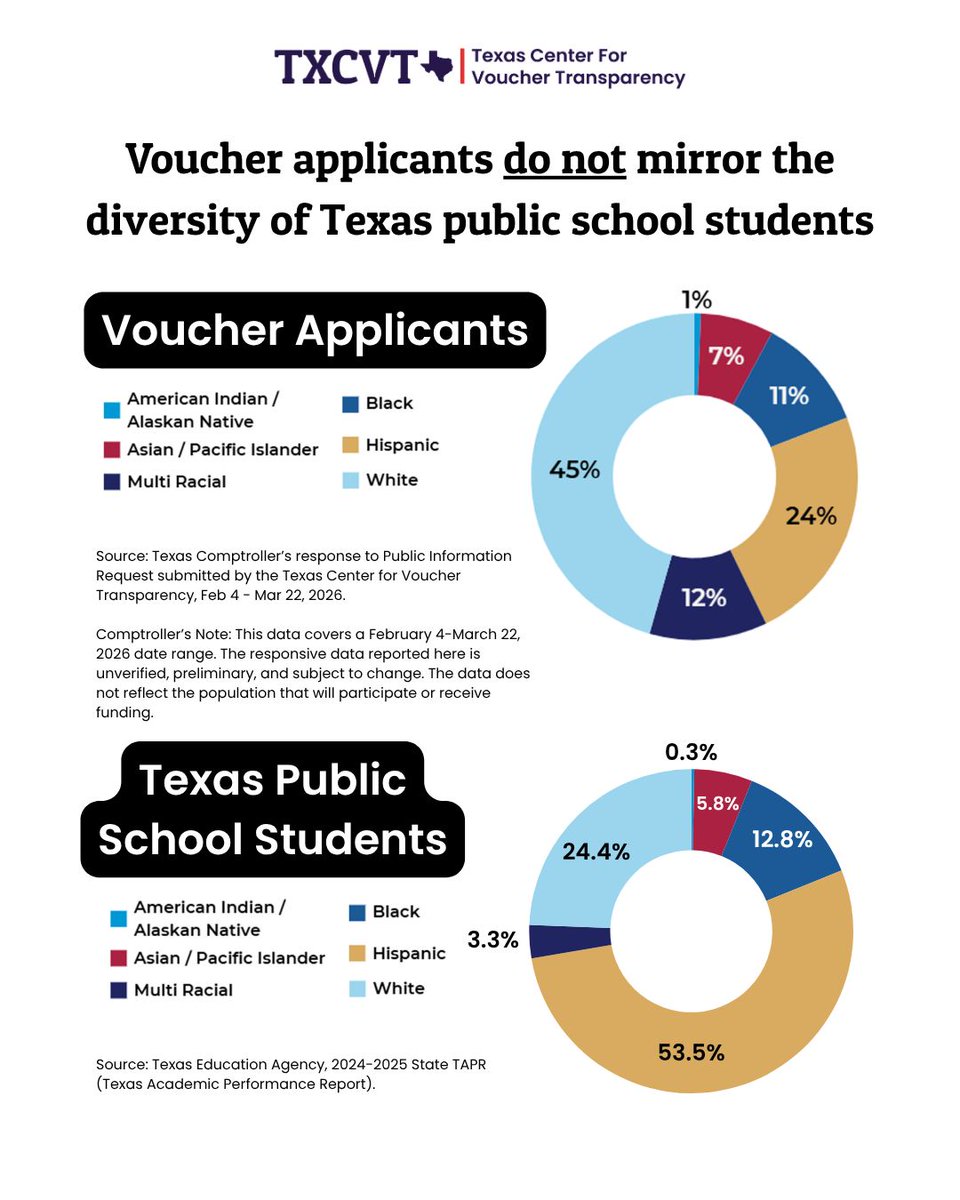
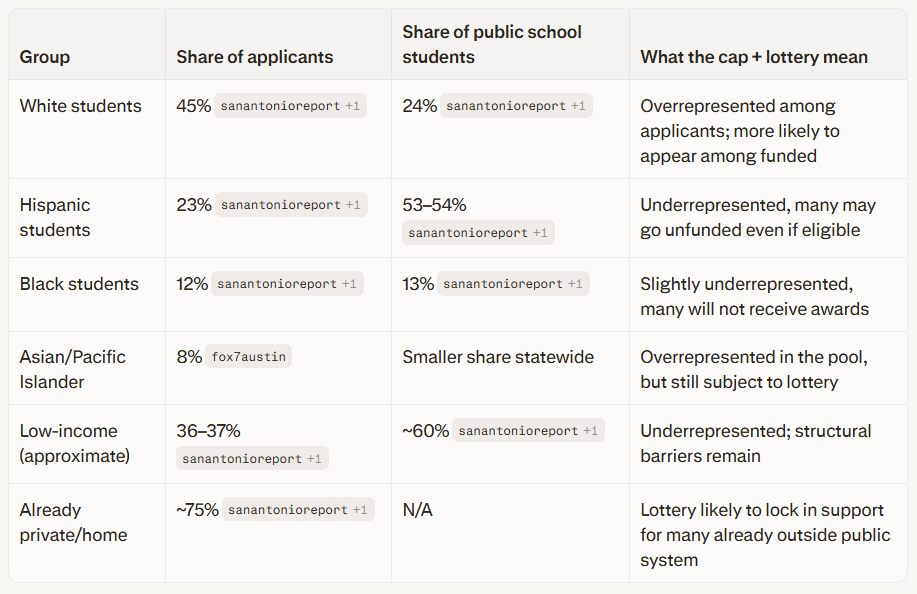
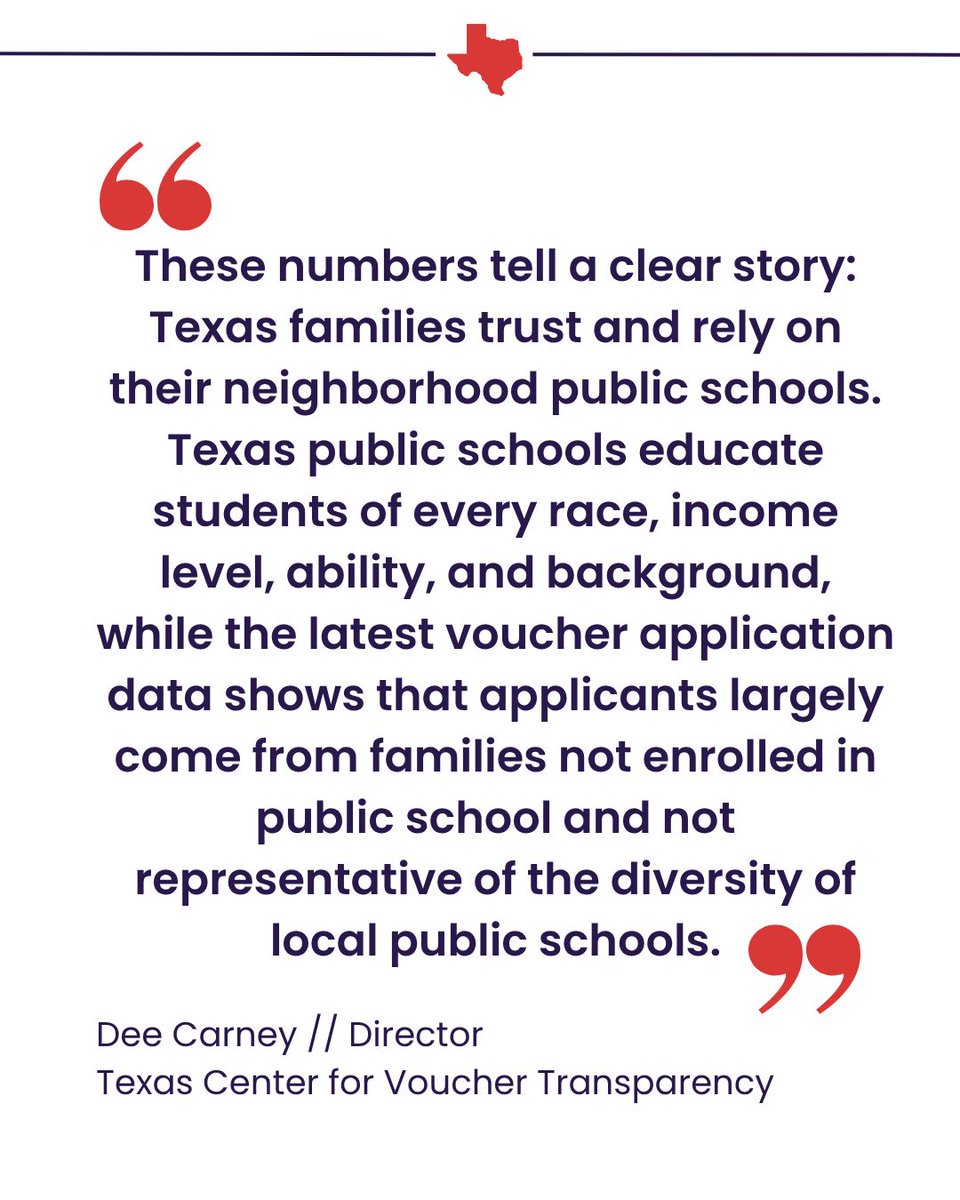
White students made up about 45% of voucher applicants, even though they are only about 24% of all Texas public school students.
Hispanic students are 53–54% of Texas public school enrollment but only about 23% of voucher applicants.
Black students are about 13% of enrollment and 12% of applicants.
Asian/Pacific Islander students account for roughly 8% of voucher applicants, a higher share than their portion of public school students.
Economically, the divide is just as sharp:
Around 63% of applicants come from middle- and high-income families; roughly 27% are from households of four earning at or above about $165,000.
Only about 36–37% of applicants are from low-income households, even though around 60% of all Texas public school students are considered economically disadvantaged.
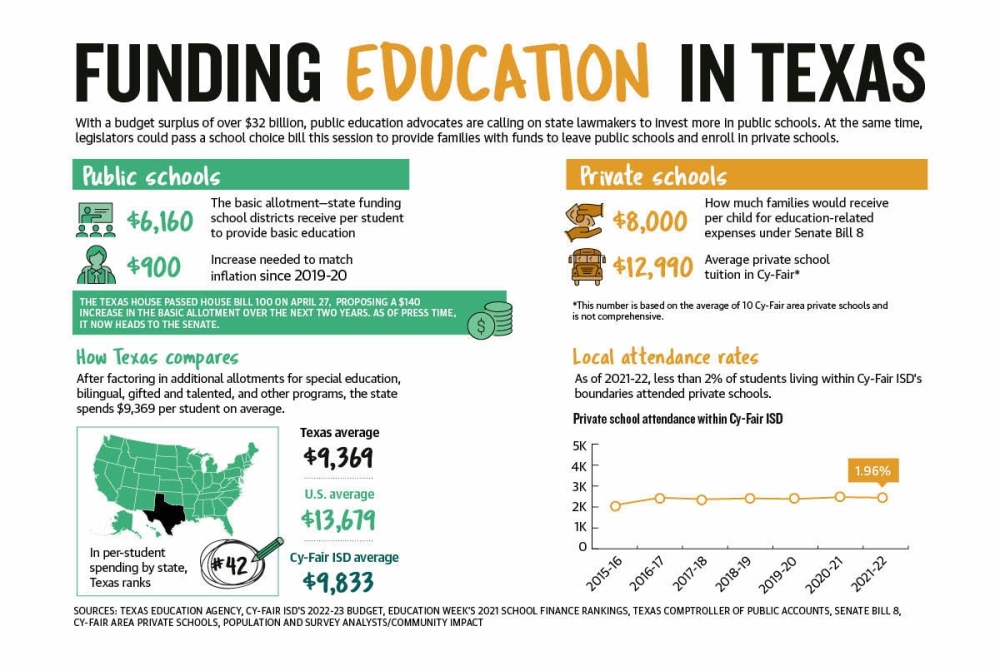
An estimated 75% of applicants were already in private school or homeschooled before applying.
Now overlay that with the funding cap and lottery: the state has a hard ceiling on how much can be spent, and accounts will be awarded in part by random selection among eligible applicants. That means:
Many families who did apply—including minority families—will simply not receive funding.
The program’s first year will primarily serve those who were already closer to private education: whiter, more affluent households with prior private or homeschool experience.
For families who never applied—whether because of limited information, language barriers, or skepticism—the policy can still reshape their local schools as dollars follow the students who leave.
Application snapshot as the lottery begins
What This Means Now That the Window Is Closed
Hispanic families: majority in schools, minority in the applicant pool
Hispanic students are the majority in Texas public schools, but they are underrepresented in the TEFA applicant pool and will now be underrepresented among funded accounts. In Latino-majority areas like San Antonio, local reports showed high application volumes, but still not at the level of Hispanic students’ presence in neighborhood schools.
With the application window closed:
Many Hispanic families who did not apply will watch funds leave their districts without any direct benefit for their own children.
Many who did apply will hear “no” from the lottery, even if their application was technically approved, because the cap has been reached.
This is not a failure of individual families. It is a design that concentrates benefits in certain demographics while distributing risk across communities.
Asian and other communities: selected access, shared risk
Asian/Pacific Islander families appear to be somewhat overrepresented among applicants, and some of those students will receive accounts and move into selective private schools. But because awards are capped and randomized, even well-positioned families will not all be funded.
Indigenous and multiracial students, already small in number, face the same structural reality as other students of color: their chances now depend on their place in a lottery, their eligibility tier, and whether there is a culturally safe, voucher-accepting school nearby that will admit them.
The Other Side of the Equation: Where Funded Families Can Go
Even for those who “win” the lottery, the question remains: where can they actually spend these dollars?
Texas has more than 2,200 private schools approved to receive TEFA funds. Private schools, unlike public schools, are not required to serve every student in a geographic area, and they can set their own admissions standards, religious expectations, and disciplinary policies.
State-level data show:
About 41% of Texas private school students are students of color, compared with more than 70% in public schools.
Many of the most established voucher-eligible schools are majority-white or affiliated with religious and cultural traditions that do not reflect the communities most harmed by inequitable public education.
Smaller, community-rooted schools that primarily serve Black, Hispanic, or Asian students exist, but they are a minority of the list and heavily clustered in major metro areas.
Texas does not maintain a public, official list of voucher-approved, minority-owned schools, so families cannot simply search for “Black-owned” or “Latino-owned” TEFA schools and make a quick match. That means even some families who receive accounts may find that the realistic choices available do not align with their child’s culture, language, or needs.
For Families: Making Sense of the “Yes,” “No,” or “Not Yet”
Whether your child will receive a TEFA award or not, this policy touches your life.
If you applied and are waiting:
Remember that a funded account is not guaranteed; watch for official communication from the state and verify award status directly through the TEFA portal, not just social media.
Treat any award as an invitation to ask hard questions of private schools, not a requirement to say yes to the first seat offered.
If you applied and are denied funding:
Your child still has the right to a high-quality education in their public school, including special education services and language supports that private schools are not required to provide.
You retain power as a voter, advocate, and organizer in your district to push for changes in curriculum, discipline, and resource allocation.
If you never applied:
You are not “behind.” The system has already been designed to limit access through caps and lotteries; opting out of an inequitable process is not a personal failure.
Your voice still matters in shaping what happens next: whether there will be future rounds, how public schools respond, and which community-rooted alternatives receive support.
In all three cases, Black, Hispanic, Asian, Indigenous, and multiracial families can keep asking: Who is my child becoming in this school, and who is this system asking them to be?
For Minority-Led Schools: Using TEFA Without Letting It Use You
For Black churches, Latino community organizations, Asian cultural centers, and other minority-led institutions, the closing of the TEFA window is not the end of the conversation; it is the beginning of a planning season.
If you are considering accepting TEFA dollars in future cycles:
Study this year’s patterns
Who applied from your community? Who got funded? Where did they go? The first-year data will tell you a lot about whether the program aligns with your mission—or pulls you away from it.Secure your foundation before scaling
Use this waiting period to strengthen curriculum, special education capacity, bilingual supports, and financial systems so you are not reliant on a volatile funding stream.Protect your governance and values
Design leadership and board structures that keep decision-making in the hands of the people most impacted: Black, Latino, Asian, Indigenous parents and educators from your neighborhood.Diversify your revenue
TEFA is capped and political. Build parallel revenue through philanthropy, social enterprise, and community-powered models so that a future legislative session cannot make or break your school.
TEFA can be a tool, but it should never become your master.
Where Do We Go From Here?
The TEFA application window has closed, the lottery is running, and a limited pot of money is being divided in ways that will shape our children’s lives. Some families will receive awards and face new decisions about private schools. Many more—especially among Black, Hispanic, Asian, and low-income communities—will not.
In this moment, our power does not come from a state email saying “Congratulations.” It comes from what we do together:
Demanding transparent, disaggregated data on who is funded and where those dollars go.
Naming the underrepresentation of Hispanic, Black, and low-income families in both applications and awards.
Supporting minority-led, community-rooted schools that are building rigorous, culturally grounded alternatives—with or without vouchers.
Insisting that public schools, which still serve the vast majority of our children, become places where every learner can see themselves, grow themselves, and graduate with real choices.
If you are a Texas parent who wants more than a lottery and a seat in someone else’s system, I want to invite you into a different kind of conversation.
Visit BEAM Microschool Academyat https://beammicroschool.org to learn how a community-rooted, project-based microschool in North Texas is designing learning spaces where Black, Hispanic, Asian, and other students of color are seen, heard, and prepared for the future they deserve.
And if you want to stay ahead of what’s coming next—whether it’s vouchers, new accountability rules, or fresh models of school—join our broader B.E.A.M. Education movement at https://www.beameducation.org. When you register there, you’ll get the latest news, tools, and invitations to experiences designed to help your family navigate this shifting landscape with clarity, courage, and community.


